
A single negative review can reduce your online visibility by 30%, according to BrightLocal's 2023 study. Most businesses know reputation management exists. Far fewer understand what actually happens after they sign with an agency.
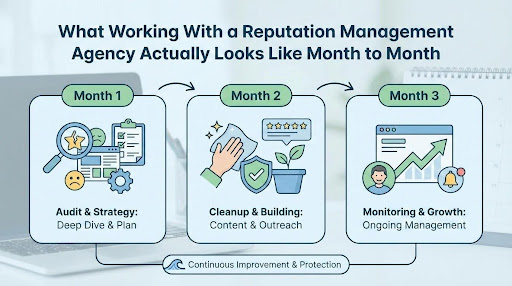
This is what the process looks like across a 12-month engagement, from the first audit through long-term maintenance.
Month 1: Onboarding and Initial Audit
The first month is almost entirely diagnostic. A reputation management agency needs to understand your current position before making any moves, which means mapping every corner of your digital presence before touching anything.
Expect interviews with your team, data collection, and a thorough audit of search results, review platforms, and social profiles. Most agencies deliver a full audit report and a 90-day action plan by the end of week four.
What the Audit Actually Covers
A proper audit runs across five areas:
- SERP analysis: Tracking top results for brand-plus-location queries to identify what you control and what you do not
- Sentiment scoring: Categorizing all online mentions as positive, neutral, or negative using tools like Brand24
- Review platform audit: Pulling ratings and reviews from Google, Yelp, and Facebook across all locations
- Competitor benchmarking: Comparing your visibility position against two or three direct competitors
- Risk prioritization: Flagging urgent issues using a high, medium, or low matrix
The audit typically wraps within 72 hours of data collection. Your team reviews findings in an initial meeting, and the agency presents a customized 12-month roadmap with specific KPIs tied to your situation.
Strategy Development
The roadmap built in month one drives everything that follows. It assigns targets such as negative result suppression rates and reputation score improvement, and outlines which channels and tactics will move each metric.
Four pillars typically anchor the plan: suppression of negative content, amplification of positive assets, review management, and ongoing monitoring. A contingency layer covers algorithm updates and unexpected escalations.
Onboarding & Audit
Full diagnostic of your digital presence — SERP analysis, sentiment scoring, review platform audit, competitor benchmarking, and risk prioritization — culminating in a 12-month roadmap.
Months 2 and 3: Building the Foundation
With the audit complete, the agency shifts to building what you will use to push negative results down. This phase is less visible externally but sets everything else up.
The primary work here is profile optimization. Agencies target consistency across 50+ directories using tools like BrightLocal and Yext, ensuring your business name, address, and phone number match across all directories. Google Business Profile gets priority attention since it influences roughly 65% of local search results.
Profile Optimization Checklist
Key steps in this phase include:
- GBP verification with 15 or more photo uploads
- NAP consistency audit across all directory listings
- Category optimization with a primary category and up to five secondary ones
- Schema markup implementation using JSON-LD for rich snippet eligibility
- Review widget embedding to surface star ratings prominently in search
Content Creation Begins
Alongside profile work, agencies launch an initial content push. A typical rollout in months two and three includes four guest posts on sites with a domain authority of 70 or higher, three press releases distributed through a service like PRWeb, and several video testimonials.
These assets serve a structural purpose. They give search engines more positive, authoritative content to index under your brand name, which is the foundation of any suppression strategy. Companies like NetReputation approach this phase with a sequenced content calendar, spacing releases to avoid triggering spam signals while building consistent momentum.
Building the Foundation
Profile optimization across 50+ directories, Google Business Profile prioritization, and an initial content push of guest posts, press releases, and video testimonials.
Months 4 Through 6: Active Suppression
This is where the visible work accelerates. The agency is now producing and publishing at volume, with 25 or more new positive assets going live across multiple channels over these three months.
The goal is straightforward: fill the first two pages of search results with content you control. Negative results do not disappear. They get pushed to page three or beyond, where very few users ever look.
Handling Negative Reviews
Review response has its own protocol during this phase. A tiered approach typically works as follows:
- A public reply within 24 hours acknowledging the issue
- A private resolution offer via direct message
- Platform escalation for reviews that violate the terms of service
- Legal review for high-stakes claims
The Positive Content Push
Beyond reviews, the amplification effort during months four through six typically includes an employee review campaign targeting authentic five-star submissions, HARO responses to land media features, podcast outreach, and premium guest posts on high-authority domains.
All of it is tracked. SERP positions are checked weekly. The account manager adjusts pacing and targeting based on what is moving and what is not.
Active Suppression
25+ positive assets published across multiple channels. Tiered review response protocol. HARO outreach, podcast features, and weekly SERP tracking.
Months 7 Through 9: Amplification
By month seven, the suppression work is producing results. This phase builds on that momentum by scaling social proof and broadening reach.
Video testimonials become central. Real clients sharing real experiences carry more weight in both traditional search and AI-generated answers than written content alone. Agencies coordinate production and distribution across YouTube, LinkedIn, and Instagram.
Social Media Scaling
A scaled social presence supports the broader content strategy during this phase. Typical output includes:
- 50 or more weekly posts across LinkedIn, Twitter, and Instagram managed through a scheduling tool like Hootsuite
- LinkedIn employee advocacy, with staff sharing company updates and client results
- Twitter thread series built around customer stories
- Short-form video repurposed from testimonials for Instagram and YouTube
Influencer outreach also comes into play here, targeting niche creators whose audiences align with your industry. Partnerships are evaluated for authentic fit, not just follower count.
Amplification
Video testimonials, scaled social output (50+ weekly posts), employee advocacy, influencer partnerships, and short-form video distribution across YouTube, LinkedIn, and Instagram.
Months 10 Through 12: Monitoring and Maintenance
The final phase of the first year shifts the engagement toward sustainability. The agency institutionalizes monitoring so that new threats surface early, before they compound.
Tools like Brand24 run continuous alerts across platforms. Custom KPI dashboards track 20+ metrics, including SERP positions for branded queries, review velocity, sentiment trends, and share of voice vs. competitors.
What Monthly Reporting Looks Like
Reports at this stage are detailed. A standard 12-page monthly report covers:
- SERP rankings for branded and unbranded queries
- Review generation rates and average star rating trends
- Online mention volume with sentiment breakdown
- ROI tracking tied to measurable business outcomes
Monthly meetings with your account manager walk through the data and confirm priorities for the following month. Nothing is set-and-forget. Even strong results require active maintenance as competitors adjust and algorithms update.
Monitoring & Maintenance
Continuous Brand24 alerts, 20+ KPI dashboards, detailed 12-page monthly reports, and monthly account manager reviews to keep results on track.
Long-Term Engagement Structure
Most agencies offer tiered service structures once the initial 12-month engagement concludes. The right tier depends on your exposure, industry, and how actively your brand is being searched or discussed. A 24-hour crisis SLA matters significantly more to a healthcare organization or public executive than to a local retailer with stable reviews.
Quarterly strategy reviews and annual competitor audits keep the work current. The engagement that delivered results in year one needs recalibration in year two. That is not a failure of the process. It is how the process is supposed to work.